Spend five minutes on TikTok, YouTube Shorts, or Instagram Reels, and you’ll probably hear someone say:
“You don’t need a heat press anymore. DTF has changed everything.”
That line gets repeated constantly now, especially in short-form videos where creators are trying to make printing look fast, easy, and almost magic. The problem is that a huge number of beginners are being shown UV DTF while simply calling it “DTF”. Before long, people start thinking all DTF printing works without heat, without fabric, and without a heat press machine.
That is where the confusion starts.
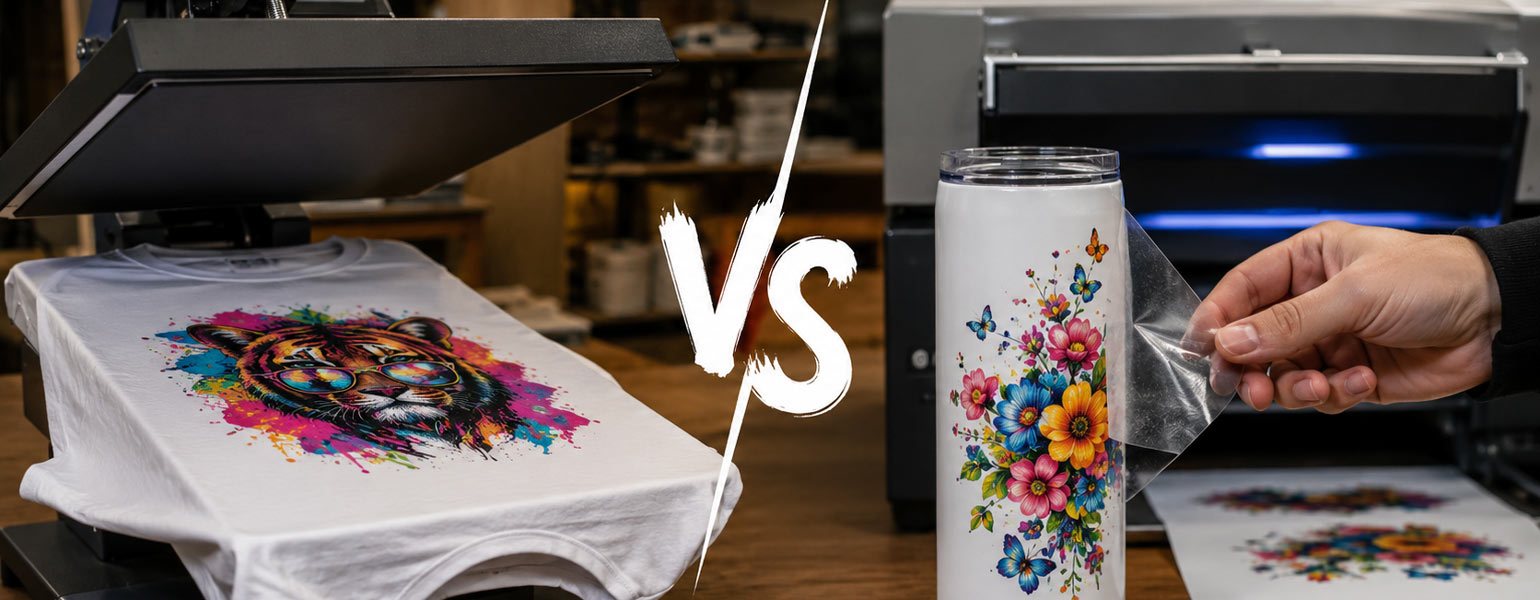
The reality is that UV DTF and traditional DTF are two completely different printing methods. They use different materials, different machines, different application processes, and they are designed for different types of products.
One is mainly for fabric and textiles.
The other is mainly for hard surfaces.
Yet online, especially in viral videos, they often get lumped together as if they are the same thing. That has led to many new businesses in the UK buying the wrong equipment, ordering the wrong blanks, or assuming they can start a T-shirt business without ever needing a heat press.
Unfortunately, that usually ends with wasted money and frustration.
So let’s properly break this down in a practical, straightforward way.
Not in the overcomplicated “industry jargon” style. Just real-world information from the perspective of people actually working with these machines and materials every day.
Traditional DTF and What It Actually Means
When people originally started talking about DTF printing, they were referring to Direct to Film printing for garments and fabrics.
This is the standard DTF process most print shops use today.
The workflow is fairly straightforward:
- A design is printed onto special PET transfer film using DTF ink.
- Adhesive powder is applied to the printed film.
- The powder is cured with heat.
- The transfer is pressed onto fabric using a heat press machine.
That last step matters.
A heat press is not optional in normal DTF printing.
No matter how many viral videos say otherwise, standard DTF transfers still require proper heat and pressure to bond to fabric correctly.
Without enough pressure or temperature, transfers can peel, crack, lift at the edges, or wash out early.
This is one reason experienced users still care a lot about pressure adjustment on heat press machines. In fact, one of the biggest complaints recently in online printing communities is that some automatic heat presses do not apply enough real pressure for DTF transfers, especially on thicker garments or puff-style prints.
People often assume every printing issue is temperature-related, but in DTF, pressure is just as important.
How Traditional DTF Printing Works
Traditional DTF is designed mainly for textiles.
That includes:
- T-shirts
- Hoodies
- Tote bags
- Sweatshirts
- Aprons
- Workwear
- Sportswear
- Cotton blends
- Polyester garments
One reason DTF became so popular in the UK is that it solved problems that sublimation printing could not.
Sublimation only works properly on polyester or polymer-coated surfaces, usually white or light colours.
DTF changed the game because it can print on:
- Cotton
- Dark garments
- Mixed fabrics
- More complicated materials
That flexibility made it extremely attractive for small businesses, Etsy sellers, local clothing brands, and side hustles.
The basic process usually looks like this:
Step 1: Create the Artwork
Designs are prepared in software with transparent backgrounds.
Most people use:
- Photoshop
- Illustrator
- CorelDRAW
- RIP software
Colour management matters more than beginners realise.
Step 2: Print Onto PET Film
The DTF printer prints colour first, then white ink behind the image.
This creates the opacity needed for dark garments.
Step 3: Apply Adhesive Powder
The wet ink is coated with hot-melt adhesive powder.
This powder is what allows the design to bond to the fabric later.
Step 4: Cure the Powder
The powder is melted and cured using heat.
Some users use curing ovens.
Others use hover curing with a heat press.
Step 5: Heat Press Onto the Garment
This is the key stage many viral videos completely skip over.
The transfer is applied using:
- controlled temperature
- firm pressure
- proper pressing time
Without a heat press machine, traditional DTF simply does not work properly.
So What Exactly Is UV DTF?
UV DTF is a completely different process.
Instead of printing for fabric, UV DTF is designed for hard surfaces.
The design is printed using UV-curable ink and transferred onto items using adhesive film layers.
There is no heat pressing stage onto fabric because UV DTF is not mainly for clothing.
That’s why those videos say:
“No heat press needed”
They are technically talking about UV DTF, not regular garment DTF.
But many beginners never hear the “UV” part.
That creates a huge misunderstanding.
How UV DTF Printing Works
UV DTF uses:
- UV ink
- A film system
- UV curing technology
The process usually works like this:
Step 1: Print the Design
The design is printed onto Film A using UV-curable ink.
UV lamps instantly cure the ink during printing.
Step 2: Laminate the Transfer
Film B is applied over the printed design.
This creates a peel-and-stick transfer system.
Step 3: Apply to Hard Surfaces
The transfer is pressed manually onto hard blanks.
Then the carrier film is peeled away.
No heat press is required because the transfer sticks through adhesive and UV-cured ink technology.
What Products Are Best for UV DTF?
This is where UV DTF really shines.
Especially in the UK gift and custom product market.
Popular UV DTF blanks include:
- Glass cups
- Tumblers
- Mugs
- Acrylic signs
- Phone cases
- Candle jars
- Cosmetic packaging
- Water bottles
- Plastic containers
- Wooden plaques
- Gift boxes
- Metal tins
UV DTF is incredibly popular right now because it makes small-batch customisation look fast and professional.
People see someone apply a transfer to a cup in ten seconds and think:
“This is easier than vinyl.”
That simplicity is a big reason the market exploded on TikTok.
Why Beginners Get Misled
Short-form content rewards speed and simplicity.
Nobody wants to watch a full explanation about powder curing, pressure settings, or adhesion science.
So creators often simplify everything down to:
“DTF but easier.”
The problem is that many beginners then assume:
- One printer does everything
- UV DTF works on shirts
- Heat presses are outdated
- All DTF is peel-and-stick
None of that is true.
Traditional DTF and UV DTF are closer to cousins than twins.
They share the “film transfer” concept, but the actual application methods differ significantly.
Which One Makes More Sense in the UK Market?
This depends heavily on what kind of products you want to sell.
Traditional DTF Is Still Strong for Clothing
In the UK, custom apparel is still massive.
There is steady demand for:
- local business uniforms
- sports teams
- event shirts
- hen party garments
- workwear
- small clothing brands
Traditional DTF remains one of the most flexible methods for garment decoration.
Especially for:
- dark cotton
- mixed fabrics
- low minimum orders
For many UK print shops, DTF has replaced a large portion of basic vinyl work.
UV DTF Is Growing Fast in the Gift Market
UV DTF is especially strong in:
- personalised gifts
- wedding products
- small business branding
- tumbler decoration
- cosmetic packaging
- craft fairs
A lot of UK sellers love it because:
- Setup looks simpler
- Application is fast
- No weeding is needed
- Full-colour designs look premium
That said, UV DTF also has limitations.
It is not ideal for:
- stretchy fabrics
- washable garments
- soft textiles
Trying to use UV DTF like garment DTF is a common beginner mistake.
Common Mistakes People Keep Making
Mistake 1: Buying UV DTF, Thinking It Replaces Garment DTF
This is probably the biggest confusion online right now.
People want to start a T-shirt business and accidentally buy UV DTF supplies because videos make it look easier.
Then they realise:
UV DTF is mainly for hard surfaces.
Not clothing.
Mistake 2: Thinking Any Heat Press Works for DTF
Pressure matters a lot.
Some cheap automatic presses struggle with:
- thick garments
- seams
- puff transfers
- heavy DTF layers
Good pressure consistency still matters in professional DTF printing.
Mistake 3: Ignoring Material Compatibility
UV DTF works beautifully on some surfaces and terribly on others.
Surface texture, coatings, oils, and curvature all affect adhesion.
Not every blank behaves the same.
Mistake 4: Using Cheap PET Film and Powder
A lot of beginners focus only on the printer.
But low-quality film and adhesive powder can destroy print quality.
Poor peeling, edge lifting, dull colours, and wash issues often come from consumables, not the printer itself.
Mistake 5: Believing Viral Videos Too Easily
Many videos are made for engagement, not education.
You usually do not see:
- failed transfers
- durability problems
- pressure testing
- long-term washing results
Real production work is always more complicated than a 15-second clip.
Why Heat Press Machines Still Matter
Despite all the online hype around “no heat needed” printing, heat press machines are still one of the core tools in the garment printing industry.
Especially for:
- traditional DTF
- sublimation
- heat transfer vinyl
- patches
- apparel decoration
In fact, many experienced print shops are moving back toward more manual pressure control because accurate pressure still solves a lot of common transfer problems.
That’s one reason professional equipment suppliers still place so much focus on pressure stability, heating consistency, and long-term durability.
Companies like Signzworld continue to supply heat press machines, sublimation blanks, and vinyl-cutting solutions because these workflows remain very much active in real-world production.
UV DTF is absolutely exciting and growing quickly.
But traditional DTF is not disappearing.
And despite what social media sometimes suggests, heat press machines are still a necessary part of proper garment DTF printing.