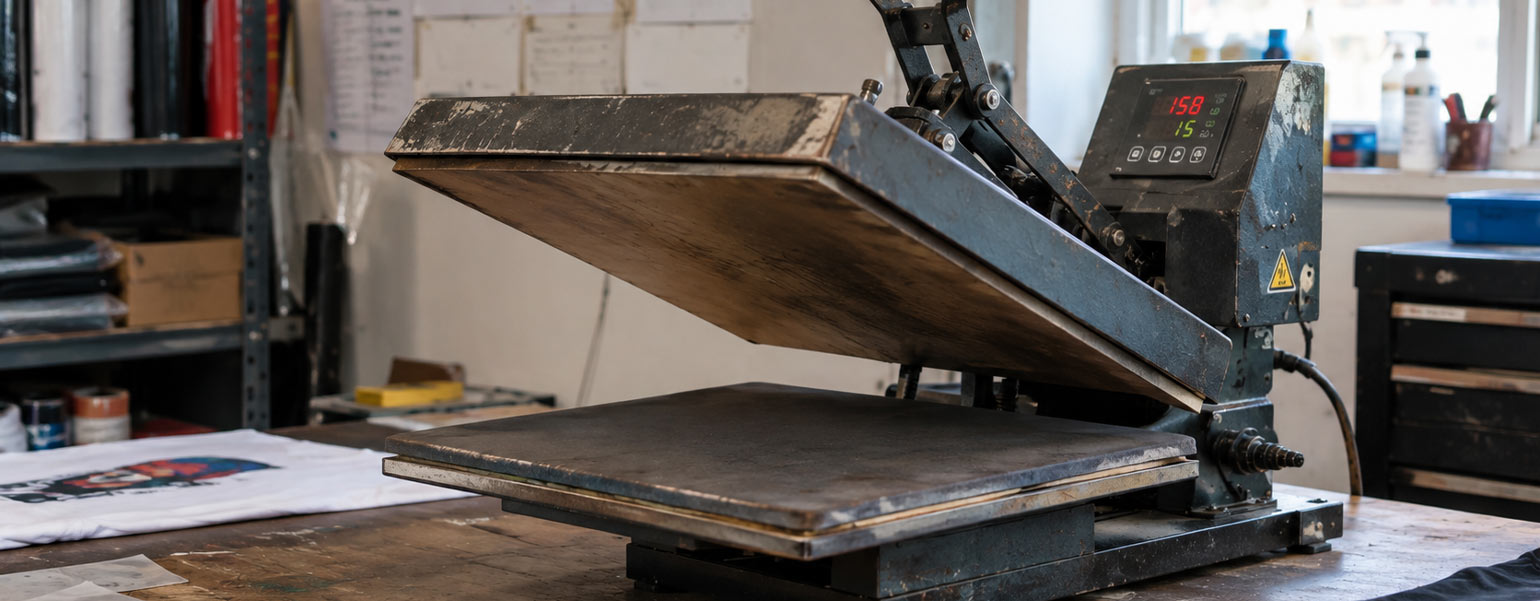
Every heat transfer business reaches this point eventually.
The heat press that has been part of the workshop for years starts behaving a little differently. It takes longer to reach temperature. One corner of the platen seems hotter than another. The pressure does not feel quite right anymore. Perhaps the handle has become harder to operate, or you have started checking the temperature display more often than you used to.
At first, none of these problems seems serious enough to justify replacing the machine.
So you repair it and carry on.
Then another problem appears a few months later.
This is where the decision becomes less straightforward. Should you keep repairing an older heat press because the individual faults are relatively minor, or would buying a new machine actually make more sense for your business?
There is no universal age at which a heat press should be replaced. A machine’s working life depends heavily on how often it is used, how it has been maintained and how it has been operated over the years.
A press used occasionally by a small business can remain reliable for many years. Another machine running continuously in a busy production environment may experience significant wear much sooner.
Rather than relying on a manufacturer’s suggested lifespan, it is more useful to look at what the machine is doing today.
Start With the Problems, Not the Age
The age of a heat press is worth considering, but it should not be the deciding factor on its own.
A five-year-old machine that has been properly maintained and still produces consistent results may be a much better investment than a newer press that has been heavily used and poorly maintained.
The more useful question is:
Is the machine still doing its job reliably and efficiently?
That means looking beyond whether it can still produce a successful transfer.
If you have to compensate for inconsistent temperature, apply pressure differently for different areas, allow extra heating time or repeatedly check whether the machine is working correctly, the problem is no longer simply the age of the press. It is beginning to affect production.
And that is when the cost of keeping an old machine running can become less obvious.
Temperature Inconsistency Is a Serious Warning Sign
Temperature is one of the most important variables in heat transfer printing.
If the heat press does not maintain a consistent temperature across the platen, transfer quality can become unpredictable. You may see differences in colour, adhesion or image quality even though you are using the same settings and materials.
A press showing a slightly inaccurate temperature reading does not automatically mean it needs replacing.
The first step is to check the actual platen temperature with a suitable temperature measuring device and compare it with the machine’s display. If the problem is caused by a sensor, controller or another replaceable component, a repair may be perfectly sensible.
The situation changes when temperature inconsistency becomes persistent or difficult to correct.
If one part of the platen repeatedly runs hotter or cooler than another, particularly when the difference is large enough to affect your transfers, you have to ask whether repairing the heating system will provide a reliable long-term solution.
For a business producing orders every day, inconsistent temperature can create more than wasted blanks. It can mean reprints, additional labour and customers receiving products that do not meet the expected standard.
When Repair Makes Sense
A repair is usually worth considering when:
- The temperature problem has a clearly identifiable cause.
- The heating element or sensor can be replaced.
- The rest of the machine remains in good condition.
- The repair cost is relatively small compared with replacement.
- The press is otherwise producing consistent results.
When Replacement May Be More Practical
Replacing the machine becomes more attractive when temperature problems keep returning, several components are already showing signs of wear, or the cost of restoring reliable heating approaches the price of a suitable new press.
There is little benefit in repairing one major fault only to discover another one shortly afterwards.
Uneven Pressure Can Be Just as Troublesome
Temperature tends to get most of the attention, but pressure is equally important.
A heat press needs to apply pressure consistently across the working area. If the platen does not close evenly, the pressure at one side may be different from the pressure on the other.
The results can be frustratingly inconsistent.
One part of a design may transfer perfectly while another does not. Large graphics can be particularly revealing because they cover more of the platen and make pressure differences easier to spot.
Uneven pressure can sometimes be corrected through adjustment, alignment or replacement of worn components. On a press that is otherwise in good condition, that can be a sensible repair.
Mechanical wear becomes more concerning when the platen, hinges, springs, pressure mechanism or frame have all been used heavily for years.
A machine can still close and open normally while gradually becoming less consistent.
If you find yourself changing pressure settings more often simply to compensate for the machine, that is worth paying attention to.
Slow Heat-Up Times Are Easy to Ignore
A heat press taking a little longer to warm up does not sound like a major problem.
If it used to reach working temperature quickly and now takes noticeably longer, however, something has changed.
The cause could be relatively simple. A heating element may be deteriorating, the electrical system may need attention, or another component may be affecting the machine’s performance.
Whether it is worth repairing depends on the cause and the overall condition of the press.
There is another issue that is easy to overlook: production time.
Imagine a press that takes an extra five minutes to reach temperature every morning. That alone may not seem important. But a machine that also needs longer recovery times between presses, more frequent temperature checks and occasional reheating during production can gradually add a surprising amount of time to a working day.
For a hobbyist, that may not matter.
For a business producing hundreds of transfers or finished products each week, it can.
Mechanical Wear Tells Its Own Story
Some signs of an ageing heat press are obvious.
The handle becomes loose. Hinges develop play. Screws repeatedly need tightening. The pressure mechanism feels rough. The platen no longer moves as smoothly as it once did.
None of these symptoms necessarily means the machine needs to be replaced immediately.
Mechanical parts are designed to wear, and many can be serviced or replaced.
The important question is how extensive the wear has become.
If replacing one worn component restores the machine to normal operation, repair is usually the straightforward option. If several mechanical parts are worn at the same time, the calculation becomes different.
A useful way to think about it is to look at the machine as a whole rather than focusing on the latest fault.
If you have already replaced one component this year, the pressure mechanism is beginning to wear, the heating system is becoming unreliable, and the machine needs regular adjustment, another repair may only postpone the inevitable.
When Repairs Start Becoming a Pattern
This is often the point where the decision becomes clearer.
One repair does not necessarily mean you have an old machine that needs replacing.
Repeated repairs are different.
Suppose a heat press develops a temperature problem. You repair it, and everything seems fine. A few months later, the pressure mechanism needs attention. Then the handle starts causing problems. Later, the heating system becomes inconsistent again.
Individually, each repair may seem reasonable.
Together, they tell you something about the condition of the machine.
There is also the time involved in arranging repairs, waiting for parts and testing the press afterwards. If production has to stop every time something goes wrong, the true cost is higher than the repair invoice.
This is one reason experienced operators tend to look at reliability, not simply repair cost.
Increasing Production Time Is a Hidden Cost
A heat press does not have to completely fail to become expensive.
Sometimes the machine continues working, but it becomes slower.
Perhaps it takes longer to heat up. Maybe you need more time between presses because the platen loses temperature. You may need to check every item more carefully because you are no longer confident that the pressure and temperature are consistent.
Each change seems small.
Together, they can have a noticeable effect on productivity.
Consider a busy production day. If every press cycle takes only a few seconds longer, that difference adds up over dozens or hundreds of products. Add occasional reprints caused by inconsistent transfers, and the lost production time becomes even more significant.
This is where an older heat press can become expensive without ever appearing on a repair bill.
The machine may technically still work, but it is no longer working as efficiently as it once did.
Compare the Cost of Repair With the Cost of Replacement
There is no magic percentage that tells you exactly when a repair is too expensive.
Instead, look at the broader picture.
If a repair is relatively inexpensive and the machine is otherwise in good condition, fixing it can make perfect sense. There is no reason to replace a reliable press simply because one component has failed.
On the other hand, if the machine needs several repairs and its performance is already declining, buying a new heat press may be financially sensible even when the existing machine can still be repaired.
Think about:
- The cost of the immediate repair
- The likelihood of further repairs
- Lost production time
- Wasted blanks and transfer materials
- Additional labour
- The reliability of the machine after repair
- The cost of a suitable replacement
- How heavily the press is used
The cheapest option today is not always the cheapest option over the next two or three years.
Don’t Forget About Your Own Time
There is one cost that is particularly easy to overlook: your time.
If you regularly have to adjust, test, troubleshoot or monitor an ageing heat press, you are spending working time on the machine instead of on production.
A small business owner might be able to live with that for a while. But once you have employees relying on the press, the consequences become more obvious.
Nobody wants a production operator standing beside a machine wondering whether the temperature is actually correct.
Reliable equipment allows people to concentrate on the work rather than constantly compensating for the equipment.
That is one of the less obvious benefits of replacing an ageing heat press.
Your Usage Matters More Than the Number on the Calendar
Two machines of the same age can be in completely different condition.
A press used a few times a week for occasional custom orders will experience a very different level of wear from one operating throughout the day in a commercial workshop.
Usage frequency matters, but so does the way the machine has been treated.
Regular cleaning, sensible pressure settings, proper operation and routine checks can all help reduce unnecessary wear. Excessive force, rough handling and ignoring early warning signs can do the opposite.
This is why a manufacturer’s suggested lifespan should be treated as a general reference rather than a deadline.
Your own machine is the better source of information.
A Simple Way to Make the Decision
When an older heat press starts developing problems, ask yourself three questions.
Is the fault isolated?
If one component has failed and the rest of the machine is performing well, repairing it may be the sensible choice.
Is the machine still reliable after the repair?
A repair should restore normal performance rather than simply keep the machine running for a little longer.
Is the machine starting to cost more in lost production than it costs to replace?
This is often the question that matters most for a working business.
If the answer is yes, replacing the heat press becomes much easier to justify.
A Heat Press Does Not Need to Be Broken to Be Ready for Replacement
Waiting for a complete failure can sometimes be the most expensive approach.
If you rely on a heat press for daily production, replacing it only after it stops working means you are making a purchase under pressure. There may be urgent orders waiting, employees unable to work and customers expecting completed products.
By the time the machine finally fails, you may have very little choice.
It is often better to recognise the pattern earlier.
When temperature becomes inconsistent, pressure starts changing, heat-up times increase, mechanical wear becomes obvious, and production gradually slows down, take a proper look at the machine as a whole.
It may still have plenty of useful life left.
Or it may be telling you that the cost of keeping it going is starting to outweigh its value.
For heat transfer businesses, the right time to replace a heat press is not determined by its age alone. It is determined by reliability, condition, maintenance history and the effect the machine has on your production.