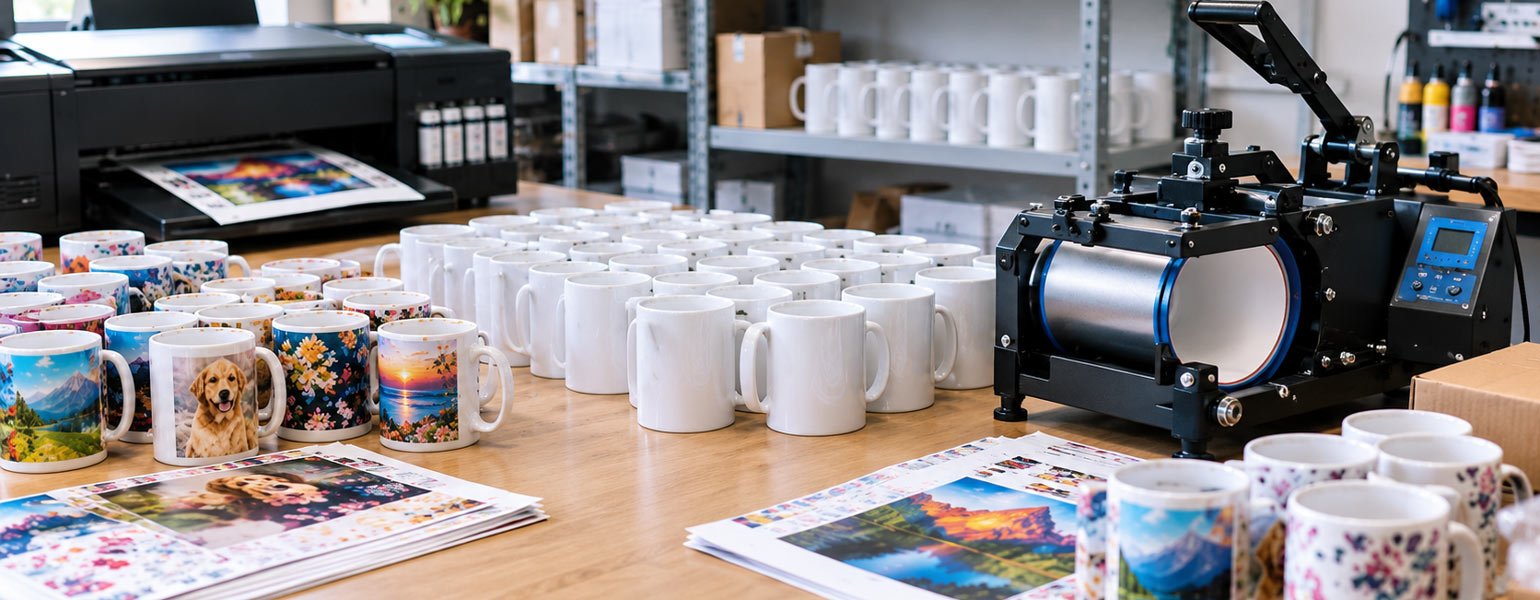
The first time you receive an order for 100 sublimation mugs, it feels like a big moment.
And it is.
For a small sublimation business, an order of that size can be genuinely exciting. It means someone trusts you with a substantial job, and the numbers on the order sheet suddenly look rather different from the usual run of personalised mugs.
You might even think, “I’ve made ten mugs before. I’ll just do that ten times.”
That is usually where the trouble starts.
Making ten mugs and making 100 mugs may involve exactly the same equipment, ink, paper and mug blanks, but the production process is not remotely the same. Once you move beyond small batches, little inefficiencies that hardly matter on ten mugs begin to multiply. A few minutes wasted here, one badly prepared design there, a mug that needs repressing, another that gets mixed up during sorting, and suddenly the job is taking far longer than expected.
The bigger problem is that many small businesses do not realise this until they are already halfway through the order.
The good news is that large sublimation orders do not have to be chaotic. You simply need to stop treating them like a collection of individual products and start treating them as a production run.
The First Thing That Changes: You Can’t Treat Every Mug as a One-Off
With a small personalised order, it is easy to give every mug your full attention.
Print one design. Press one mug. Check it. Pack it. Move on.
If something isn’t quite right, you have plenty of time to fix it.
That approach becomes expensive when you have 100 or more mugs to produce.
Imagine spending an extra two minutes making every mug absolutely perfect. Across ten mugs, that is barely noticeable. Across 100, you have added more than three hours of work.
And that is before you consider printing, sorting, cooling, quality control and packaging.
This does not mean quality becomes less important. Quite the opposite.
It means quality needs to come from a good process rather than constant improvisation.
A reliable production workflow should make the correct result the easiest result to achieve.
Start With the Artwork, Not the Mug Press
One of the easiest mistakes is to start pressing as soon as the order arrives.
There is something satisfying about getting a mug into the press, especially when you have a large order sitting on the desk. But pressing is not where a large order should begin.
Artwork preparation should come first.
For a small order, you might print designs individually as you need them. With 100 mugs, that can quickly turn into a mess.
Before printing anything, check the complete order.
Make sure names are spelt correctly. Confirm quantities. Check that every customer or design variation is accounted for. Look at the dimensions and make sure the artwork fits the intended mug correctly.
This is also the point to identify unusual designs.
Perhaps most of the mugs use the same layout, but ten have a different name position. Maybe a few contain longer text. Maybe some designs use a darker background that will require closer attention during quality control.
Deal with those details before production begins.
Create a Clear Artwork Structure
If you have 100 different names, you do not want 100 files sitting in a folder with vague filenames.
Something as simple as:
001 – Sarah
002 – James
003 – Olivia
can make a surprisingly big difference.
The exact system does not matter as much as consistency.
When a production run gets busy, you want to know immediately which printed transfer belongs to which mug.
If you can batch similar artwork together, even better. The less often you need to stop and change what you are doing, the smoother the production run becomes.
Batch Printing Makes a Bigger Difference Than You Might Expect
Printing one transfer, pressing one mug and repeating the process sounds logical.
It is not necessarily the most efficient approach for a large order.
Once your artwork has been checked, batch printing usually makes more sense.
Instead of constantly switching between your computer, printer and press, print a manageable batch of transfers at once.
For example, you might prepare 20 or 25 designs, print them, check them and move them into the production area before starting the next stage.
The exact batch size depends on your workspace, printer and order, but the principle is simple:
Reduce unnecessary movement and switching between tasks.
There is another benefit.
Batch printing gives you an opportunity to spot problems early.
If the colours suddenly look wrong, the paper feeds incorrectly, or the printer produces an unexpected result, discovering that on the first 20 transfers is considerably better than discovering it after printing all 100.
This is one of the reasons experienced production teams do not simply rush to maximise output. They build in points where mistakes can be caught before they become expensive.
Sorting Is No Longer a Minor Job
Sorting might sound like one of the least important parts of sublimation production.
It isn’t.
With ten mugs, you can probably remember which design belongs to which mug.
With 100, memory becomes a liability.
Once the transfers and blanks are separated, you need a system that keeps everything together.
A simple production line might look like this:
Artwork → printed transfer → mug blank → pressing → cooling → QC → packaging
Each stage should have a clearly defined place.
If Sarah’s transfer is placed on a table with 30 other transfers, and her mug is somewhere else entirely, you have created an avoidable problem.
For personalised orders, this matters even more.
A perfectly pressed mug with the wrong name is still a failed product.
Keep Batches Small Enough to Control
There is a temptation to lay out all 100 mugs at once.
Unless you have a very large and organised workspace, this can make things worse.
Working in controlled batches of perhaps 20–25 mugs often gives you a better balance between efficiency and control.
You can complete a batch, check it, move it to the next stage and then bring the next batch forward.
The exact number is less important than being able to answer a simple question at any point:
Where is every item in this order?
If you cannot answer that quickly, the batch is probably too large for your current setup.
Pressing 100 Mugs Is Where Small Problems Become Big Problems
This is the stage most people think about when they hear “large sublimation order”.
It is also where production discipline really matters.
When you are making a few mugs, you can watch each one closely.
With 100 mugs, you need consistency.
The mug needs to be positioned correctly. The transfer needs to be secured properly. Pressure needs to remain consistent. Temperature and time need to be controlled.
You also need to pay attention to the press itself.
A mug press can behave differently once it is being used repeatedly. Heating cycles, recovery time and the condition of the heating element can all affect consistency.
This is why it is worth doing a small test run before committing to the entire order.
Press the first few mugs and check them carefully.
If they look right, you have established a baseline.
If they don’t, stop and investigate.
It is much cheaper to spend ten minutes solving a problem at the beginning than to discover after 70 mugs that something has been wrong all afternoon.
Don’t Change Three Settings at Once
This becomes particularly important during a large production run.
Suppose the first few mugs look slightly faded.
The temptation is to increase the temperature, add more pressure and extend the pressing time.
Now you have changed three variables and no longer know what caused the improvement or made the problem worse.
Instead, change one thing at a time.
Large sublimation orders reward consistency, not guesswork.
Once you have established a working combination for the particular mug, paper, ink and press, stick with it unless there is a clear reason to change something.
Cooling Needs a Place in the Workflow
Cooling is easy to overlook because it does not feel like production.
But when you are making 100 mugs, it becomes part of the production line.
You cannot simply press a mug and immediately throw it into a box.
The mug needs time to cool, and the transfer needs to be handled appropriately to avoid unnecessary movement or distortion while the design is still hot.
More importantly, you need somewhere to put the finished mugs.
If hot mugs are being placed randomly around the workspace, you will eventually run out of room.
That is when mugs start being moved, stacked badly or mixed with unprocessed ones.
A dedicated cooling area solves a surprisingly large number of problems.
It also creates a clear distinction between:
Waiting to be pressed
and
Already pressed
That sounds basic, but clear physical separation becomes incredibly useful when you are working quickly.
Quality Control Should Happen During Production, Not Only at the End
Checking all 100 mugs after everything has been pressed might seem efficient.
It isn’t always.
Imagine discovering mug number 83 has a colour problem that was actually caused by a printer setting that changed at mug number 40.
Now you potentially have 40 or more mugs to investigate.
A better approach is to carry out quality control throughout the run.
Check the first few mugs carefully.
Then continue checking at sensible intervals.
Look for:
- Colour consistency
- Faded areas
- Ghosting
- Uneven transfer
- Incorrect positioning
- Spelling errors
- Scratches or coating defects
- Mug damage
- Design variations
For personalised products, compare the physical mug against the original order information.
Do not rely solely on the printed transfer.
A beautifully printed mug with a spelling mistake is still a mistake.
Large Orders Need a Different Definition of “Perfect”
This is one of the hardest adjustments for small sublimation businesses.
When you make one personalised mug for a customer, it is natural to spend time getting every detail just right.
When you make 100, you need to distinguish between a genuine defect and a tiny variation that does not affect the finished product.
That does not mean accepting poor quality.
It means establishing a clear quality standard before production begins.
For example, decide what constitutes an acceptable print, what requires repressing and what requires replacing the mug entirely.
Without that decision, every questionable mug becomes a debate.
And if you are working under time pressure, those little debates add up.
A good production process makes these decisions before you are standing in front of the press with 60 mugs still waiting.
Packaging Is Another Production Stage
Packaging is often left until the very end.
Then suddenly you have 100 finished mugs on a table and realise you still need to wrap, label and organise all of them.
For a small order, this may be manageable.
For a large one, packaging needs preparation just like printing does.
Have your boxes, protective materials, labels and other packaging supplies ready before the first mug is finished.
If the order contains different designs or customer names, keep the packaging sequence aligned with your production sequence where possible.
You do not want to finish pressing 100 mugs only to create another huge sorting job.
A More Reliable Workflow for 100+ Sublimation Mugs
A practical large-order workflow could look something like this:
1. Confirm the order
Check quantities, names, designs, sizes and any special requirements.
2. Prepare all artwork
Standardise layouts, check spelling and organise files using a consistent naming system.
3. Print a small test batch
Check colour, sizing and print quality before committing to the full run.
4. Print the main batches
Work in manageable groups rather than sending the entire order into production without checkpoints.
5. Prepare the mug blanks
Count them, inspect for obvious damage and organise them by batch.
6. Match transfers to mugs
Keep each design with the correct blank and maintain the order throughout production.
7. Press the first few mugs
Use these to establish that your settings and positioning are producing the expected result.
8. Move into batch pressing
Once the process is confirmed, work through consistent batches without constantly changing settings.
9. Create a dedicated cooling area
Keep finished mugs separate from those waiting to be pressed.
10. Carry out ongoing QC
Check samples throughout production rather than waiting until every mug is finished.
11. Separate rejects immediately
Anything requiring investigation or rework should have its own clearly marked area.
12. Pack in controlled batches
Keep finished products organised and avoid creating a second sorting problem at the end.
This may sound more structured than making ten mugs on a Saturday afternoon.
That’s exactly the point.
When 100 Mugs Stop Feeling Like 10
The biggest change when moving from 10 mugs to 100 is not the amount of pressing. It is the amount of organisation required around each mug.
With a small order, you can rely on memory, keep a few things in your head and fix mistakes as you go. That stops working surprisingly quickly once the order becomes larger.
A misplaced transfer, an unchecked artwork file or a mug left in the wrong batch might seem like a minor mistake. Repeated several times, it can cost hours of extra work and a fair amount of stock.
That is why the most useful shift is to stop thinking of 100 mugs as ten small orders.
Think of them as one production run with clearly defined stages.
Prepare everything before pressing begins. Work in manageable batches. Keep unfinished and finished products physically separate. Check quality throughout the run rather than waiting until the end. Most importantly, decide in advance how you will deal with anything that goes wrong.
You are not trying to make each mug individually faster. You are making the whole process easier to control.
That is the real difference between producing ten sublimation mugs and producing 100.
For businesses handling larger sublimation orders, consistent mug blanks, reliable heat presses and suitable consumables also become increasingly important. Signzworld supplies sublimation mugs, heat presses and sublimation consumables for businesses working across a range of production volumes.
The first 100-mug order should be something you learn from and build on, rather than something you simply try to get through.