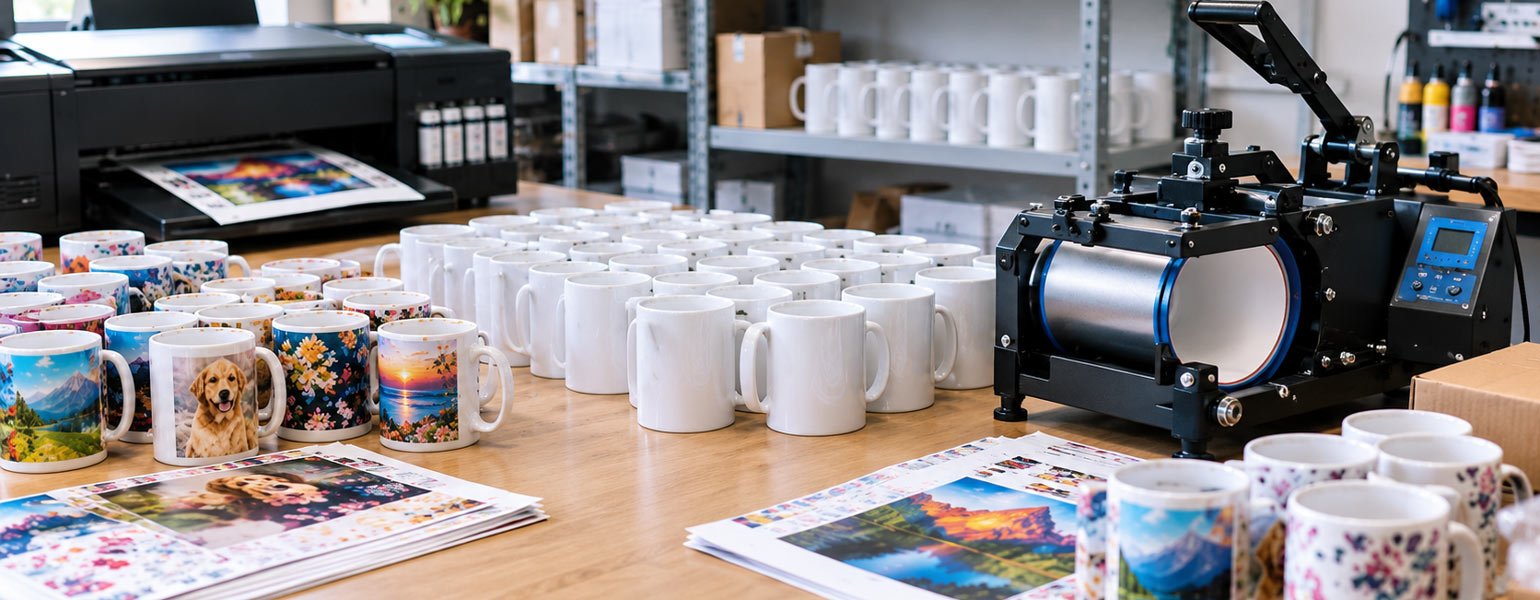
A sublimation print can look excellent right off the heat press. The colours are strong, the details are sharp, and the finished product looks exactly as expected.
Then, a few weeks later, something changes.
The colours no longer look quite as vibrant. A mug that was once bright and crisp starts looking noticeably duller. A printed polyester garment loses some of its original colour after several washes. The first reaction is often to blame the ink, the printer or the blank.
Sometimes that is justified. Sometimes it is not.
The important thing is to work out what kind of fading you are actually seeing.
If a print looks pale or has the wrong colours immediately after printing, that is usually a transfer or colour-reproduction problem rather than fading. If the print looked good when it was made but loses colour after a relatively short period of normal use, it is worth looking more closely at the materials and production process.
At the same time, no sublimation print is completely isolated from its environment. Prolonged sunlight, repeated high-temperature washing and harsh cleaning products can gradually affect colour over time, even when the original sublimation process was carried out correctly.
For a print business, knowing the difference matters. It helps you troubleshoot the right problem instead of changing settings at random or assuming that every faded print means the same thing.
Why Do Sublimation Prints Fade Too Quickly?
When a sublimation print starts losing colour after only a short period of normal use, the first place to look is the production process.
Sublimation is often described as a straightforward process: print the design onto sublimation paper, place it against the blank and apply heat and pressure.
In practice, there are quite a few things that need to work together.
The printer, ink, paper, blank, temperature, time, pressure and moisture conditions can all affect the final result. A small problem in one area may not be obvious when the product first comes off the press, but can become more noticeable later.
The Sublimation Blank Matters More Than It First Appears
A good-looking transfer does not automatically mean that the blank is suitable for long-term sublimation.
For polyester products, the material needs to be suitable for accepting sublimation dye. For mugs, metal panels and other hard products, the coating needs to be designed for sublimation and applied consistently.
This is particularly important with coated products.
A mug might come out of the press looking fantastic, but if the polymer coating is inconsistent or unsuitable, the finished print may not retain its colour as well as expected during normal use.
The same principle applies to other blanks. Two products can look almost identical before printing, yet behave differently once they have been sublimated and put into everyday use.
This is one reason experienced printers tend to pay attention to the consistency of their blanks rather than simply choosing whichever option has the lowest unit price.
It is also worth considering what the product is actually intended for. A blank designed for indoor personalised gifts should not automatically be treated as suitable for prolonged outdoor exposure simply because it can be sublimated.
Ink Quality and Compatibility Can Affect Colour Retention
Sublimation ink is another part of the equation.
The purpose of sublimation ink is not simply to produce a strong image on paper. During pressing, the dye needs to transfer effectively into the appropriate substrate or coating.
Poor-quality, unsuitable or inconsistent ink can make the process less predictable.
There can also be compatibility issues. A printer, ink and colour-management setup that work well together should be treated as a system rather than a collection of unrelated products.
This is particularly relevant when changing from one sublimation ink to another. A printer may still produce an image, but that does not necessarily mean the new ink will behave in the same way during transfer.
Storage matters too. Sublimation ink should be kept according to the manufacturer’s recommendations, rather than being left in unsuitable conditions for long periods.
If colour performance starts changing after an ink change, it is worth looking at the ink and the wider printing setup before changing the heat press settings.
Incorrect Temperature Can Affect the Transfer
Temperature is one of the first things people tend to check when a sublimation result is not right, and for good reason.
Sublimation relies on heat to transfer the dye from the paper into the suitable substrate. If the temperature is not appropriate for the material, the transfer may not develop as intended.
The important point is that there is no universal temperature that works perfectly for every sublimation product.
A ceramic mug, polyester fabric, coated metal panel and other sublimation blanks can have different recommended settings.
Using one favourite setting for everything might work reasonably well for some products, but that does not make it the correct setting for all of them.
If a print appears strong at first but does not hold its colour well, the pressing conditions are worth reviewing against the blank manufacturer’s recommendations. Temperature should be considered together with time and pressure rather than treated as a separate setting.
Pressing Time Is Just as Important
The same applies to pressing time.
Too little time can result in an incomplete or inconsistent transfer. Excessive heat exposure is not automatically better either.
This is where production experience becomes useful. When you are making one sample, it is tempting to focus entirely on whether the image looks good when the press opens. When you are producing hundreds of pieces, consistency becomes much more important.
A reliable process should produce similar results from one item to the next.
For commercial work, it is sensible to record the settings that work for each commonly used blank rather than relying on memory. That makes it easier to spot when something has changed and reduces the temptation to adjust several variables at once.
Pressure Needs to Be Consistent
Pressure can be overlooked because temperature and time are easier to talk about.
However, the transfer needs good and consistent contact between the printed paper and the sublimation surface.
If pressure is too light, uneven or inconsistent, the transfer may not be uniform.
This is particularly important with flat products and larger designs. If part of the transfer receives different pressure from another area, the final result may not behave consistently across the whole image.
It is also worth checking the condition and adjustment of the heat press itself. A press that applies noticeably different pressure across its working area can make troubleshooting surprisingly difficult.
If the centre of a design behaves differently from the edges, do not immediately assume that the ink is the problem.
Moisture Can Cause Trouble During Sublimation
Moisture is another factor that can easily be overlooked.
Paper, fabric and other materials can absorb moisture from their surroundings. During the heating process, that moisture can interfere with the transfer and contribute to inconsistent results.
This is particularly relevant in environments where humidity changes significantly.
Sublimation paper should be stored properly, and blanks should not be left exposed to unsuitable conditions for long periods. Polyester fabrics may also benefit from appropriate preparation when moisture is suspected to be affecting the transfer.
A simple moisture problem can sometimes look like a much more complicated printing issue.
Sublimation Paper Is Part of the Transfer Process
It is easy to think of sublimation paper as nothing more than something to print the design on.
It is more important than that.
The paper needs to hold the ink correctly during printing and then release it efficiently during the heat-transfer stage. Different papers can behave differently in terms of ink absorption, drying and release.
If the paper is unsuitable for the printer and ink combination, or if its performance is inconsistent, the transfer may suffer.
That does not necessarily mean a more expensive paper will always produce a better result. The important thing is whether the paper is appropriate for the particular sublimation setup and produces consistent transfers.
For businesses producing regular orders, consistency is often more useful than chasing small differences in paper price.
How to Prevent Premature Fading
Once you understand that premature fading can involve several parts of the production process, prevention becomes much more straightforward.
There is no single setting that guarantees perfect results for every sublimation product. A reliable process is built around choosing suitable materials and controlling the variables that matter.
Start With Suitable Sublimation Blanks
Choose blanks that are specifically intended for sublimation and appropriate for the finished product’s intended use.
Look beyond the purchase price.
Consistency between batches, coating quality and suitability for the application can all matter more than saving a small amount on each individual blank.
For larger orders, testing a new batch before committing to a substantial production run can save much more money than discovering a problem after hundreds of products have been printed.
Use Compatible Ink and Paper
Your sublimation printer, ink and paper should work well together.
If you change one part of the system, allow time for testing rather than assuming the existing settings will automatically produce identical results.
Keep ink and paper stored appropriately, too. Good materials can still cause problems if they are stored badly.
Follow Product-Specific Heat Press Settings
Avoid treating every sublimation blank as if it were the same product.
Follow the recommended temperature, time and pressure for the particular material or blank whenever reliable guidance is available.
This is especially important when moving between different product categories. The settings that work well for a ceramic mug are not a sensible starting point for every other sublimation application.
Keep Your Production Process Consistent
Once you have found settings that work reliably, keep them consistent.
Record the settings for frequently used blanks. Make sure operators are following the same process. Check that the heat press is functioning properly and applying heat and pressure consistently.
When a problem appears, change one variable at a time where possible.
That makes troubleshooting much easier.
If you change the paper, ink, temperature, pressing time and pressure all at once, you may eventually get a better result, but you will not know which change actually solved the problem.
Test Before Taking on Large Orders
A small test can reveal problems that are difficult to spot during a single production run.
For a new blank or a new combination of ink and paper, produce a sample and check the finished item under realistic conditions.
The aim is not to guarantee that a print will never change colour. Rather, it is to make sure the material and production process are performing as expected before committing to a large quantity.
That is particularly important for commercial orders, where a small problem repeated across hundreds of pieces quickly becomes an expensive one.
Why Sublimation Prints Can Fade Over Time With Normal Use
There is another side to the story that is easy to overlook.
Not every sublimation print that becomes lighter over time has a production defect.
Even a well-produced sublimation item is still exposed to the conditions in which it is used.
A mug kept on a sunny windowsill every day is receiving much more light exposure than one stored inside a cupboard. A polyester garment washed several times a week on a high-temperature cycle is experiencing more stress than one washed occasionally at a lower temperature.
The difference can be significant over time.
Prolonged Sunlight Exposure
UV exposure is one of the most obvious environmental factors that can affect colour.
A product placed next to a sunny window for months or left outside in direct sunlight for long periods may gradually lose some of its colour intensity.
This is not necessarily evidence that the original sublimation process was poor. The exposure itself is part of the product’s environment.
Outdoor applications therefore need to be considered differently from products intended for ordinary indoor use.
Frequent High-Temperature Washing
For sublimated polyester garments, cushions and similar textile products, repeated high-temperature washing can contribute to gradual colour fading.
The effect depends on the material, the product and the washing conditions, so it would be misleading to suggest that every high-temperature wash will cause an obvious change.
However, if a product is washed frequently at high temperatures over a long period, the cumulative effect can be different from occasional washing under gentler conditions.
Following the care instructions appropriate to the finished product is therefore sensible.
Bleach and Harsh Cleaning Products
Strong cleaning products can also affect colour.
Regular use of bleach or other harsh chemicals may accelerate colour loss, depending on the material and the way the finished product is treated.
This is another situation where the eventual appearance of a product cannot be judged solely by how it looked immediately after pressing.
The environment and cleaning routine matter too.
A Simple Way to Look at Sublimation Fading
When a customer reports that a sublimation print has faded, it is useful to ask a few basic questions before changing the production process.
Did it look correct when it was first produced?
If not, the issue is more likely to involve colour reproduction or the transfer process.
How long did it take before the colour noticeably changed?
A significant change after a short period of normal use deserves a closer look at the blank, ink, paper and pressing process.
How has the product been used?
Think about sunlight, washing frequency, water temperature, cleaning products and whether the product has been used indoors or outdoors.
Was the product made from a suitable sublimation blank?
A product designed for one application may not be suitable for another simply because it accepts sublimation ink.
These questions do not provide an instant diagnosis, but they help separate a production problem from the normal effects of long-term use.
The Aim Is Consistent Colour, Not Impossible Durability
Sublimation is valued because the dye becomes part of the suitable substrate rather than simply sitting as a conventional printed layer on top. When the right materials and production conditions are used, it can produce durable and attractive results.
But durability is not determined by the printer alone.
The blank, ink, paper and heat-transfer process all play a part. So does the environment in which the finished product spends the next few months or years.
For a print business, the practical goal is therefore not to promise that a sublimation print will never fade. It is to use suitable materials, control the production process and understand the conditions in which the finished product will be used.
That is the best way to avoid premature fading while setting realistic expectations for the life of the finished product.