


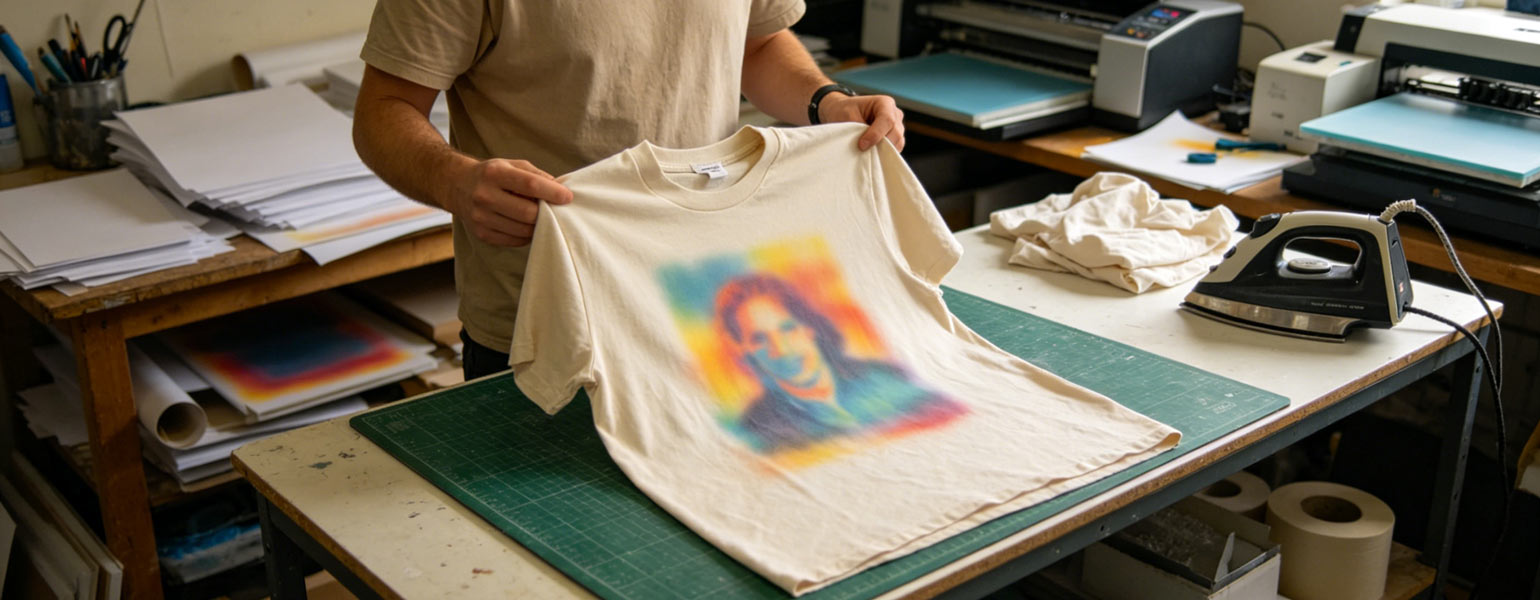
If you’ve ever dipped your toes into sublimation printing, there’s a good chance your first “proper” attempt was on a cotton T-shirt. It feels like the obvious choice. Cotton is everywhere in the UK; it’s what most of us wear day to day, and it looks like a perfect blank canvas.
Then you press it.
And nothing really happens.
Or worse, you get a faint, washed-out ghost of an image that looks nothing like the vibrant design you expected. At that point, most beginners assume they’ve messed up the temperature, the pressure, or the paper. In reality, the issue runs deeper than technique.
Sublimation simply doesn’t behave the way most people expect on cotton, and once you understand why, the whole process starts to make a lot more sense.
Starting where most beginners start: cotton feels like the obvious choice
In the UK, cotton is the default fabric. Walk into any high street shop, and most basic tees, hoodies, and home textiles are made of cotton or high-cotton blends. It’s soft, breathable, easy to wash, and familiar.
So when people first discover sublimation printing, the thinking is usually straightforward:
If I can print on mugs and polyester, surely cotton should work just as well on clothing.
That assumption is completely logical. It’s also the reason so many first-time attempts end in disappointment.
What beginners don’t realise is that sublimation printing was never designed for natural fibres like cotton. It was built around a very specific chemical interaction that cotton simply cannot support.
How sublimation printing actually works
To understand the failure, you need to understand the mechanism.
Sublimation printing uses heat to turn solid dye into a gas without passing through a liquid phase. That gas then bonds with polyester fibres at the molecular level, becoming part of the material itself.
In simple terms, the dye does not sit on top of the fabric. It becomes the fabric.
This is why sublimation prints are:
- Extremely vibrant
- Long lasting
- Resistant to cracking or peeling
- Smooth to the touch
But all of that only works if the material can accept the gas-state dye and lock it inside its structure.
Polyester does exactly that. Cotton does not.
Why does cotton fail every time with sublimation
Cotton is a natural cellulose fibre. It has a very different structure compared to synthetic polyester.
When sublimation ink turns into gas, it needs a polymer structure to bond with. Cotton fibres don’t have that kind of molecular openness. They absorb liquid, but they do not “lock in” sublimation dye.
So what actually happens when you press cotton?
The ink tries to transfer, but instead of bonding, it either:
- Sits on the surface and fades quickly
- Burns off under high heat
- Transfers extremely weakly, resulting in a dull, ghost-like image
No matter how perfect your temperature or pressure settings are, the chemistry simply isn’t there.
This is the part many beginners struggle with. They keep adjusting the printer, the heat press, or the paper, thinking the issue is technical. But sublimation on cotton is not a settings problem. It’s a material limitation.
A common beginner story: the “first hoodie mistake”
Most people in this space have a version of the same experience.
You buy a blank cotton hoodie because it feels like a safe starting point. You spend time designing something clean and bold. You press it at what you think are correct settings, peel the paper, and immediately feel confused.
The colours look faded. Almost like a washed-out version of your file. You try again, maybe increase the temperature slightly, maybe press longer. It gets worse, not better.
At this point, most beginners assume they’ve bought bad ink or cheap paper.
But the truth is simpler and slightly frustrating: cotton was never part of the system.
The one workaround that sometimes confuses people
There is one reason cotton sometimes appears to “work” in videos or social media posts. That is the use of special coatings. The most common types beginners will come across include polyester sprays (like Poly T or EasySubli Spray) and liquid polymer coatings (such as SubliCoat or Forever Subli-Light). These are usually sold online or through specialist suppliers and are often marketed as a solution for printing on cotton. Recognising these coating names can help if you want to experiment and see how they perform in practice.
Polyester spray or polymer coating can temporarily give cotton a surface that accepts sublimation ink. In theory, this bridges the gap.
In practice, results vary a lot.
If you do try this approach, there are a few important considerations:
- The coating must be applied evenly
- Oversaturation leads to patchy prints
- Undersaturation leads to weak colour transfer
- Wash durability is usually lower than that of true polyester sublimation
It can be useful for experimentation or niche projects, but it is not a reliable production method, especially if you are aiming for consistent quality.
A more reliable approach: work with the process, not against it
Once you accept that sublimation printing is fundamentally polyester-based, the workflow becomes much simpler.
Instead of forcing cotton into the process, the better strategy is to choose materials that are designed for it.
This is where most successful small print businesses in the UK quietly shift their focus. Not because cotton is bad, but because polyester-based blanks are simply more predictable and commercially viable.
Best alternative fabrics that actually work well
If you’re targeting the UK market, several widely used alternatives consistently produce strong sublimation results.
Polyester T-shirts
This is the most direct replacement for cotton. Modern polyester tees are soft, breathable, and widely available. They are especially popular in sportswear and promotional clothing.
High polyester blends produce the most vibrant results.
Polyester-cotton blends
Often called poly-blends or tri-blends depending on composition. These are a good compromise if you want a more natural feel while still achieving decent print quality. For the best results with sublimation on blends, look for fabrics with at least 65 percent polyester content. This gives the ink enough polyester to bond with and ensures that colours come out vibrant and long-lasting.
The higher the polyester percentage, the better the result.
Polyester hoodies and sweatshirts
These are extremely popular in the UK custom apparel markets. They hold colour well and are widely used for branded merchandise.
Polyester tote bags
A surprisingly strong product category. They are cheap, easy to press, and very popular for custom gifting and retail packaging.
Polyester cushion covers
Home décor is a growing segment in the UK. Polyester cushions hold sublimation prints well and are commonly used for personalised interiors.
Polyester sportswear fabrics
Gym wear, cycling kits, and team kits are almost entirely polyester-based. Sublimation works exceptionally well here due to the fabric’s structure and durability.
Why polyester dominates sublimation success
Once you work with polyester, several things immediately improve:
- Colours become significantly more vibrant
- Details remain sharp even on complex designs
- Wash durability increases dramatically
- Production becomes more consistent and repeatable
In other words, polyester removes the unpredictability that cotton introduces.
A small but important technical insight most beginners miss
One of the biggest misconceptions is that sublimation is “printing on fabric.”
It’s not.
It is actually a controlled dye migration process. That distinction is why material choice matters more than almost anything else.
You can have a perfect printer, premium ink, and accurate temperature control, but if the fibre cannot accept dye at a molecular level, the result will always be limited.
This is also why sublimation behaves so differently from vinyl or screen printing. Each system interacts with materials in completely different ways.
Bringing it back to real-world use in the UK
In the UK market, cotton still dominates everyday clothing. That will not change. But in the sublimation space, cotton is more of a learning trap than a practical substrate.
Most experienced printers eventually adopt a hybrid approach:
- Cotton for everyday retail wear
- Polyester for sublimation-based custom products
- Blended fabrics for middle-ground applications
This separation helps avoid wasted material and inconsistent output, especially when scaling production.
A practical note from real-world printing experience
One of the most consistent lessons in sublimation printing is that success often comes from simplification.
New users tend to experiment too widely, trying different fabrics, temperatures, and techniques all at once. But the most reliable results usually come from narrowing your variables and working within known material limits.
Once you commit to polyester-based blanks, your learning curve becomes significantly smoother.
A final practical reference point for blanks and materials
If you are looking for reliable sublimation blanks and materials that are already widely used in the UK market, Signzworld offers a range of sublimation-friendly products designed specifically for consistent heat transfer results. Their blanks are commonly used across apparel, home décor, and promotional items, making them a practical reference point when building a more stable production workflow.


