


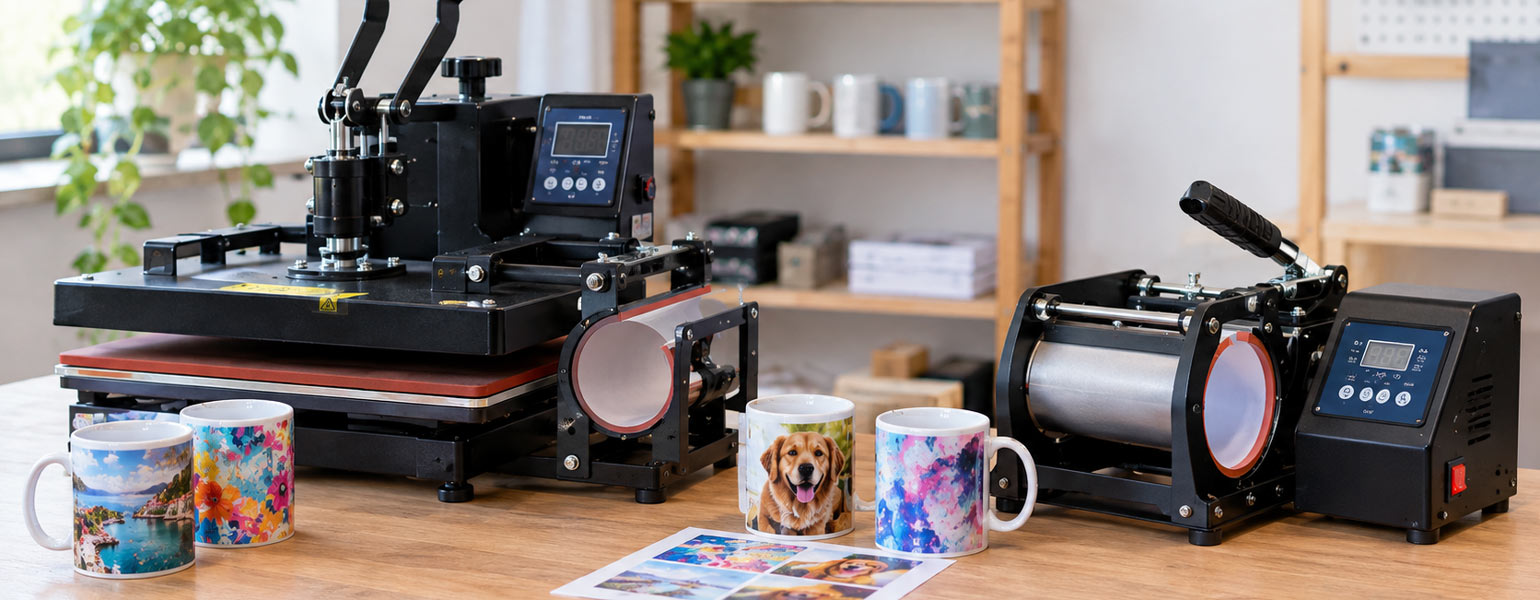
If you already own a multi-function heat press, you may not need a separate mug press to start making sublimation mugs. Both can produce good results, but the finished print’s consistency depends on how evenly you apply heat and pressure to the mug, as well as the quality of the blank.
A dedicated mug press can make regular mug production easier, especially for larger orders. However, it is not automatically the better option in every situation. Before investing in another machine, it helps to understand what actually makes a difference to print quality.
What Is the Difference Between a Multi-Function Heat Press and a Mug Press?
A multi-function heat press, often sold as a 5-in-1 or 8-in-1 machine, uses interchangeable attachments to print different products. Depending on the model, these may include flat platens for T-shirts, attachments for mugs and tumblers, and accessories for caps or plates. A dedicated mug press is designed specifically for cylindrical drinkware.
The main differences are in heating, pressure and workflow. A mug attachment must fit the shape and diameter of the mug closely enough to maintain even contact across the printable area. If the heating element does not fit properly, some areas may receive less heat or pressure than others. The same issue can occur with a dedicated machine if its heating element, adjustment mechanism or mug compatibility is unsuitable.
A dedicated press is generally more convenient if you produce mugs regularly, as there is less need to change attachments between different products. A multi-function machine offers greater flexibility and may be perfectly adequate for occasional mug printing alongside T-shirts, cushion covers and other flat items.
The important point is that the type of machine alone does not determine print quality. Heating consistency, pressure distribution, the fit of the attachment and the quality of the mug coating all matter.
Why Can a Multi-Function Heat Press Produce Uneven Mug Prints?
Imagine someone who has been using a 5-in-1 heat press for months. They regularly print T-shirts and cushion covers, and the results are consistently good. Then they decide to try the mug attachment.
The first few mugs look acceptable, but subsequent prints have pale areas near the bottom, while parts of the design close to the handle look less defined. They adjust the temperature, increase the pressing time and tighten the pressure. The results still vary.
It is easy to conclude that the mug attachment is simply not good enough. However, changing settings repeatedly may not solve the underlying problem.
A few factors are worth checking:
- Uneven contact: If the heating blanket does not sit closely against the mug, some areas may receive less heat or pressure.
- Incorrect pressure: Too little pressure can cause inconsistent transfer, while excessive or uneven pressure may create other problems. The correct adjustment depends on the machine and mug.
- Mug size and shape: An attachment designed for a particular diameter may not suit every mug. Tapered or unusually shaped blanks can be especially difficult to press evenly.
- Temperature stability: The displayed temperature does not necessarily tell you how evenly the heating surface maintains heat throughout a pressing cycle.
- Mug coating and preparation: An inconsistent sublimation coating, unsuitable blank or poorly secured transfer paper can affect the result even when the press is working correctly.
These issues are not exclusive to multi-function machines. They can also affect dedicated mug presses, so it is worth identifying the likely cause before deciding that the equipment needs replacing.
What Do Real Mug Pressing Problems Tell Us?
Discussions among sublimation printers illustrate why the problem is not always as straightforward as changing the temperature or buying a different machine.
On the Dyesub Forum, one user reported that the first 24 white mugs printed successfully, but later mugs developed faded areas at the bottom and vertical banding despite using the same settings. The user suspected uneven pressure from the adjustment mechanism.
This is a useful reminder that consistent settings do not guarantee consistent results. Pressure, equipment condition, and the fit of the mug can all warrant investigation, although the discussion does not establish a definitive cause.
In a Reddit discussion, another user described ghosting and burning around the handle area. Replacing an existing press with a Cricut Mug Press did not resolve the same problem.
The precise cause was not confirmed, but the experience highlights an important point: replacing a machine does not necessarily fix a problem caused by the mug blank, transfer positioning or another part of the process.
Neither case proves that one type of press is inherently better. Instead, both show why it is important to look at the whole printing process rather than blaming the machine immediately.
Should You Upgrade to a Dedicated Mug Press?
The answer depends on how often you print mugs and whether your current equipment can produce reliable results.
If you only make mugs occasionally, a multi-function heat press may be a sensible choice. It allows you to work with different products without investing in separate machines, provided the mug attachment is suitable and produces consistent results.
If mugs account for a significant part of your business, a dedicated press may be worth considering. A machine designed around mug production can make the workflow more straightforward, reduce attachment changes and help you maintain consistency across repeated jobs. These advantages are particularly useful when fulfilling larger orders, where uneven prints can lead to wasted blanks, additional labour and missed deadlines.
Before upgrading, however, check the basics. Make sure the mug matches the attachment, the heating element fits correctly, the transfer paper is secure, and the machine is operating as expected. If the same defect appears repeatedly, test another suitable mug blank and follow the manufacturer’s recommended settings. This can help you distinguish an equipment issue from a problem with the materials or process.
When choosing a new press, look beyond the number of functions or the headline temperature range. Consider the types of mugs you need to print, the consistency of the heating element, pressure adjustment, available replacement parts and how frequently you expect to use the machine.
For businesses producing a wide range of personalised products, flexibility may be the priority. For those concentrating on regular mug orders, a dedicated press may offer a more practical day-to-day setup.
Signzworld supplies heat press machines, mug attachments and sublimation blanks for different production needs. Choosing equipment that matches your products and workload is a better starting point than assuming one machine type will always deliver superior results.


