If you’re just getting into sublimation or heat transfer printing, this is one of those decisions that looks small on paper—but feels huge in real life.
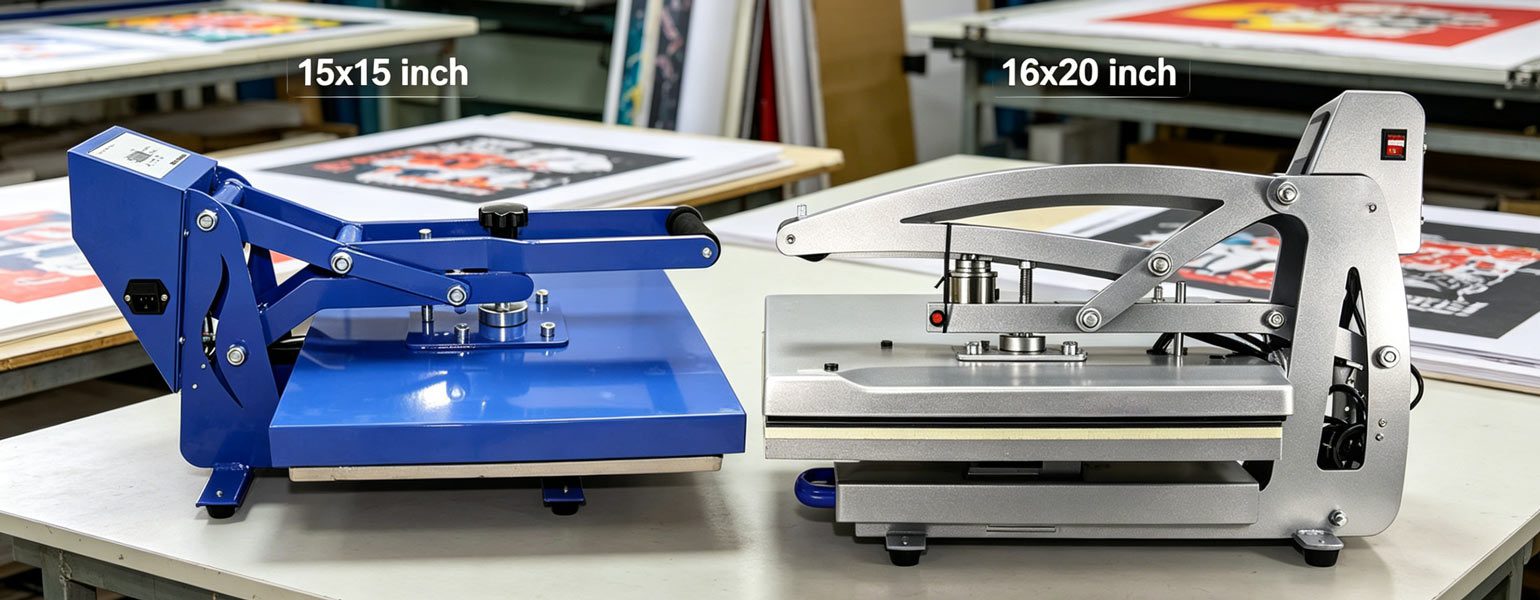
15×15 inch vs 16×20 inch heat press.
Just one inch here, five inches there… doesn’t sound like a big deal, right?
Yeah—until you actually start printing.
Why these two sizes dominate the market
Scroll through almost any supplier catalogue, and you’ll notice something interesting:
→ Most flat heat press machines fall into two categories:
- 15×15 inch (38×38 cm)
- 16×20 inch (40×50 cm)
This isn’t random.
The real reason is balance.
Manufacturers aren’t just picking sizes—they’re balancing:
- Cost vs usability
- Workspace vs production needs
- Power consumption vs performance
A typical 15×15 machine, like a 15×15 Heat Press Machine, is considered the entry-level industry standard, while something like the ePhotoInc 16×20 Heat Press Machine steps into semi-commercial territory.
→ In short:
- 15×15 = minimum viable professional size
- 16×20 = growth-ready size
The size difference: small numbers, big impact
Let’s make it real:
- 15×15 = 225 square inches
- 16×20 = 320 square inches
That’s over 40% more surface area.
And that changes everything.
What can you actually print?
This is where most beginners underestimate the difference.
15×15-inch heat press: what it’s perfect for
A 15×15 press covers most daily-use sublimation blanks:
- Standard T-shirts (front chest prints)
- Tote bags
- Cushion covers
- Mouse pads
- Baby clothes
- Small hoodies
- Coasters and tiles
→ In fact, many small businesses report that T-shirt printing alone accounts for the majority of their work, making this size highly practical
Where it starts to struggle:
- Oversized designs
- Full-front hoodie prints
- A3 / large-format prints
- All-over sublimation alignment
16×20 inch heat press: where it shines
That extra space unlocks a different level of flexibility:
- Large graphic T-shirts (streetwear style)
- Hoodies (full chest/back)
- Sweatshirts
- Large tote bags
- Pillowcases (full print)
- MDF panels, signage
- Sublimation panels and plaques
→ You also get:
- More room for positioning
- Less need to repress or reposition
Printing experience: Is bigger easier?
Surprisingly—yes.
With a 15×15:
- You need precise placement
- Less margin for error
- Risk of “half-pressing” large designs
With a 16×20:
- You get breathing room
- Easier alignment
- Better for beginners working with large transfers
→ Bigger platen = less stress during setup
Calibration & pressure: any difference?
Technically, both machines work the same way:
- Temperature
- Time
- Pressure
But in practice:
15×15
- Heats faster (smaller plate)
- Easier pressure adjustment
- More forgiving for small items
16×20
- Takes slightly longer to heat
- Requires more consistent pressure across the surface
- Better for uniform large transfers
Power consumption & running cost
Let’s talk real-world numbers.
A typical 15×15 press:
- Around 1200–1400W
A 16×20 press:
- Usually 1600–2000W+
What that means:
- Slightly higher electricity cost for larger machines
- Longer heat-up time
- More heat output (important in small workspaces)
→ But honestly?
For most small businesses, the difference is noticeable—but not deal-breaking.
Material usage: hidden cost difference
Here’s something beginners often miss:
→ Bigger press = bigger designs = more consumables
With a 16×20:
- You’ll use more:
- Transfer paper
- Ink
- vinyl
With a 15×15:
- Easier to stay efficient and reduce waste
The beginner dilemma: should you “buy bigger”?
This is the question.
Let’s be real:
Myth: “Buy big to future-proof”
Sounds smart—but not always.
If you:
- Have a limited budget
- Are still learning
- Don’t yet have customers
→ A large machine can:
- Sit unused
- Waste money
- Take up space
Reality: match your current business stage
Choose 15×15 if:
- You’re just starting
- Focused on T-shirts & small items
- Budget is tight
- You want faster ROI
Choose 16×20 if:
- You plan to sell hoodies / oversized prints
- You already have some orders
- You want to avoid upgrading later
- You have space + budget
A practical way to decide
Ask yourself one question:
→ “Will I regularly print designs bigger than A4 size?”
- If NO → 15×15 is enough
- If YES → go 16×20
Simple—but surprisingly accurate.
Side-by-side comparison
| Platen Size | 15×15 inch | 16×20 inch |
| Best For | T-shirts, small items | Hoodies, large prints |
| Learning Curve | Easier | Slightly higher |
| Workspace Needed | Compact | Larger |
| Power Usage | Lower | Higher |
| Flexibility | Medium | High |
| Cost | Lower | Higher |
So… what should you actually buy?
If you’re being honest about your situation:
→ Most beginners should start with 15×15.
It’s:
- Proven
- Cost-effective
- Enough for 80% of use cases
And when your business grows?
→ You’ll upgrade with confidence, not guesswork.
A note on choosing the right brand
No matter the size, build quality matters just as much.
Brands like Signzworld offer both:
- 15×15 entry-level machines for startups
- 16×20 options for scaling businesses
Their machines typically focus on:
- Stable heat distribution
- Reliable pressure systems
- Practical pricing for small businesses
One last thing
Your first heat press is not your last.
So instead of chasing the “perfect” machine:
→ Choose the one that helps you start faster, learn quicker, and earn sooner.
Because in this business, momentum beats perfection every time.