


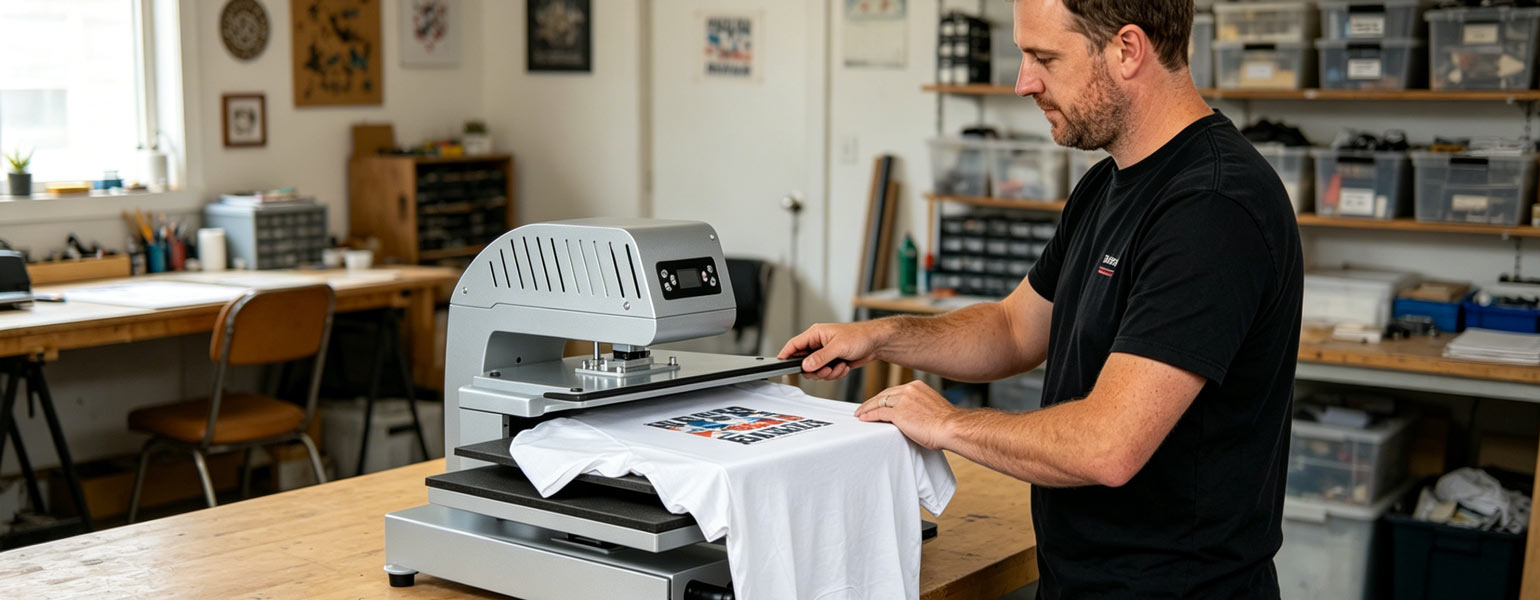
Over the past year or two, Auto Heat Press machines have absolutely exploded in popularity.
You can see it everywhere now.
TikTok creators use one-touch presses in tiny home studios. Etsy sellers upgrading from mini presses. YouTube reviewers are comparing automated models from brands such as HTVRONT, Cricut, and VEVOR. Even people who have never used a heat press are suddenly buying one because DTF side hustles have made custom apparel feel accessible.
And honestly, Auto Heat Press machines do solve a lot of old problems.
Traditional clamshell presses can feel intimidating. They are heavy, bulky, and sometimes genuinely annoying to use for long periods. Auto presses feel cleaner and easier. Push a button, wait a few seconds, and the machine opens itself. For beginners, that experience feels modern.
That is why so many people rushed toward them.
But something interesting started happening after the hype phase.
The more people actually used these machines for real projects, especially DTF and puff vinyl, the more one issue kept coming up:
Pressure.
Not temperature.
Pressure.
If you spend even half an hour browsing Reddit threads about Auto Heat Press machines in 2026, you start noticing the same conversations repeating over and over again.
People saying things like:
“My DTF looks fine until I wash it.”
“My puff vinyl keeps coming out flat.”
“The middle presses fine, but the edges peel.”
“This machine works for basic HTV but struggles with thicker materials.”
And the funny part is that many of these users initially thought the problem was temperature.
So they kept increasing the heat settings.
Higher temp. Longer pressing time. More troubleshooting.
Then, eventually, somebody in the comments says:
“You probably don’t have enough pressure.”
That is the moment a lot of people realise Auto Heat Press machines are not all built the same.
The Industry Accidentally Trained Everyone to Focus Only on Temperature
For years, heat press marketing revolved around temperature.
320°F for this.
385°F for that.
400°F for sublimation.
Temperature charts became the centre of everything.
But pressure is harder to market because most beginner users do not really understand what it does until something starts failing.
The reality is that heat alone does not create a durable transfer.
Pressure is what forces the adhesive into the fabric fibres. It is what creates full surface contact. It is what helps thicker materials compress properly during pressing.
Without enough pressure, you often get transfers that look decent on day one but start failing later.
And that is exactly why this topic exploded alongside DTF printing.
DTF Quietly Exposed Weak Auto Heat Press Machines
Back in the HTV-only days, many machines could get away with weaker pressure.
Simple vinyl lettering on a cotton shirt is relatively forgiving.
DTF is not.
DTF adhesive powder needs proper compression to bond consistently with fabric. If the pressure is too weak, the adhesive sits too close to the surface instead of locking into the fibres properly.
That is why so many Reddit users now complain about:
- peeling corners
- cracked transfers
- washed-out textures
- lifted edges after laundering
Especially on hoodies and heavyweight garments.
And honestly, puff vinyl made the issue even more obvious.
Because puff vinyl reacts immediately to poor pressure.
When the pressure is weak, the puff effect becomes uneven. Some areas rise correctly while others stay flat. Sometimes the finish looks strangely shiny or partially melted instead of soft and raised.
A lot of people using compact Auto Heat Press machines discovered this the hard way. If you want to avoid those same headaches, there are a few simple ways to check your pressure. Try placing a pressure test strip, a small piece of parchment paper, or even a sheet of scrap transfer in opposite corners of your press along with your main garment. Press as normal, then check if all areas show the same even transfer. If the edges look faded or the design is weaker in certain spots, your pressure is probably too low or inconsistent. Some users also place a thin sheet of paper across the closed platen and lightly tug it: if it slides out easily, the pressure isn’t uniform. Adjust the pressure settings if your machine allows, or try doubling up with a heat pressing pillow to improve contact on thicker items. A few quick tests like these can help ensure you get solid, durable results no matter what material you’re pressing.
Why Do So Many Auto Heat Press Machines Have Pressure Problems?
This is where things get interesting.
Most beginner-friendly Auto Heat Press machines were designed around convenience first.
That is not necessarily a bad thing.
But convenience creates compromises.
A lightweight desktop machine simply cannot generate the same kind of compression force as a heavier clamshell or pneumatic press designed for production work.
That becomes especially obvious with:
- DTF
- puff vinyl
- thick hoodies
- layered transfers
- textured garments
Some Auto Heat Press machines also rely on semi-automatic pressure systems that are more limited than people realise. In a semi-automatic pressure system, the machine adjusts pressure based on the thickness of the item being pressed, but does not allow users to set or fine-tune exact pressure levels the way manual or true automatic systems do. Manual pressure systems usually have a knob or dial that lets you directly control how much force the press applies. Fully automatic systems often feature digital controls that allow for precise, programmable pressure settings. By contrast, semi-automatic models try to balance convenience with basic adjustment, but often fall short when working with a variety of materials, since you can’t guarantee consistent force across different projects.
The marketing often says “auto pressure adjustment,” which sounds impressive at first.
But in reality, some machines are mostly adjusting to thickness, not truly allowing strong manual pressure control.
That is a huge difference.
Because different materials need different levels of force.
And once users move beyond beginner crafting into actual small business production, those limitations become noticeable very quickly.
The Problem Is Not Just “Weak Pressure”
The bigger issue is inconsistent pressure.
That is what causes so many frustrating results.
A machine may press perfectly in the centre but be weaker near the edges.
Or it may work well on thin cotton shirts, but struggle badly once you move to thicker hoodies.
That is why you see so many people online saying things like:
“It works great for regular HTV but not for DTF.”
Usually, that is not random.
DTF simply exposes pressure inconsistency faster.
Different Materials React Very Differently to Pressure
This part gets overlooked a lot.
Not every material responds to heat in the same way.
Fabric absorbs pressure. Metal does not. Wood has texture. Glass has almost zero forgiveness.
For fabric applications like DTF and HTV, pressure helps the adhesive penetrate the fibres properly. Without enough compression, the transfer stays too close to the surface.
For ceramic mugs and sublimation blanks, pressure controls contact consistency. Weak pressure creates faded areas or ghosting because the transfer paper is not fully touching the coated surface evenly.
Metal blanks are even less forgiving because the surface itself does not compress at all. Any uneven pressure becomes visible immediately in the final image quality.
And with wood, the natural grain texture means pressure matters more than many beginners expect. Heat alone cannot compensate for uneven surface contact.
This is why experienced print shops care so much about pressure systems. They already know temperature is only one part of the equation.
A Lot of Buyers Are Looking at the Wrong Specs
One thing I have noticed recently is that many people shopping for Auto Heat Press machines still focus mostly on:
- touchscreen controls
- automatic opening
- heating speed
- compact design
Meanwhile, they barely check how the machine handles pressure.
That is a mistake.
Especially in 2026.
Because modern transfer materials are far more demanding than older HTV workflows.
If you are shopping for an Auto Heat Press now, pressure adjustability honestly matters more than most fancy smart features.
Not just “auto pressure.”
Real pressure control.
That means asking questions like:
Can the machine handle thick garments consistently?
Does it maintain edge-to-edge pressure?
Do experienced users report problems with DTF?
Can it properly compress puff vinyl?
Those questions matter far more than whether the screen looks modern.
Reddit Has Become Weirdly Useful for Heat Press Research
This is probably one of the funniest shifts in the industry lately.
A lot of the most honest Auto Heat Press discussions are happening on Reddit instead of YouTube reviews.
Because Reddit users are usually talking after months of actual use.
Not during sponsored unboxing videos.
And once you start reading enough threads, patterns become obvious very quickly.
You notice the same complaints repeating across multiple brands:
- pressure inconsistency
- weak adhesion on DTF
- puff vinyl issues
- problems with thicker garments
- “Looks fine until washing”
That does not mean Auto Heat Press machines are bad overall.
Some are genuinely excellent.
But it does mean buyers are becoming more aware that automatic convenience does not automatically equal professional pressing performance.
The Industry Is Already Starting to Shift Again
What is interesting now is that manufacturers clearly see this conversation happening.
You can already tell newer generations of Auto Heat Press machines are putting much more emphasis on pressure systems, stronger closing force, and better platen stability.
Because users are becoming more educated.
People are no longer impressed by automation alone.
They want consistency.
Especially small businesses.
Nobody wants to lose repeat customers because transfers start peeling after three washes.
That is also why more experienced users are starting to pay closer attention to machine structure, platen quality, and pressure control when comparing heat press equipment from suppliers like Signzworld, especially for DTF-heavy workflows and thicker material applications.
And honestly, this whole shift probably makes the industry healthier in the long run.
For years, people treated heat presses like simple hot plates.
DTF changed that completely.
Now people are finally realising that pressure is not just a small technical detail hiding in the background.
It is one of the biggest factors separating hobby-level results from professional-quality transfers.


